
Country Report: Viet Nam Developing ASEAN Economic Corridors
Associate Professor Trinh Thi Thu Huong, Ph.D.
Foreign Trade University, Viet Nam
1. Introduction
Viet Nam, with an area of 331,690 square kilometers (sq.km), officially known as the Socialist Republic of Viet Nam, is bordered by ocean to the west and south (over 3,260 km of coastline), with China to the north, Cambodia and Laos to the west (3,730 km of inland borderline). It is a densely populated country of 100.3 million people in 2023 (WHO, 2023). Industrialization has led to an increasingly concentrated population in urban areas where jobs are plentiful. Viet Namese is the primary language, with English rapidly becoming the preferred foreign language.
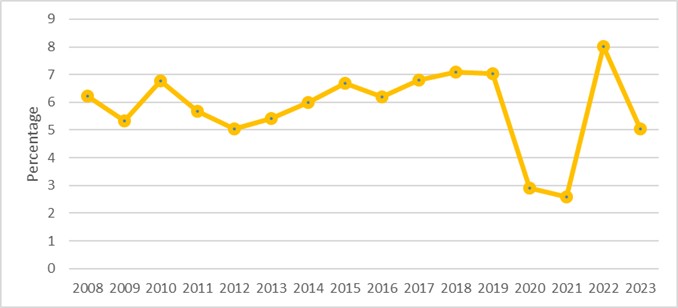
Figure 1 GDP growth rate of Viet Nam
Source: author, based on General Statistics Office (GSO) of Viet Nam data
Over the past few decades, Viet Nam has transitioned from a centrally planned economy to a market-oriented one, resulting in an average annual gross domestic product (GDP) growth rate of 6%-7%, despite the impact of the Coronavirus disease 2019 (COVID-19) pandemic (Figure 1). In 2023, Viet Nam’s GDP growth was 5.05%, due to weakening global demand and the effect of rising interest rates on domestic consumption and investment.
Vietnamese economic development depends on integration into the global supply chain and its regional strategic location. Viet Nam has joined major international organizations, diversifying supply chains to balance costs and exploit free trade agreements (FTA). Therefore, Viet Nam has entered and signed 16 FTAs with significant international partners, including major new-generation treaties such as the Comprehensive and Progressive Agreement for Trans-Pacific Partnership (CPTPP); the Regional Comprehensive Economic Partnership (RCEP); and the European Union–Viet Nam Free Trade Agreement (EVFTA).
Like other developing countries, Viet Nam’s economy depends on import-export activities and foreign direct investment (FDI) flow. Since its economy opened in 1986 and it joined the World Trade Organization (WTO) in 2007, Viet Nam’s foreign trade has prospered. From 2005 to 2023, average growth rate was 37.8% (Figure 2), reaching 730.21 billion United States dollars (USD) for the first time in 2022. From 2016 until now, exports have always exceeded imports, resulting in a positive balance.
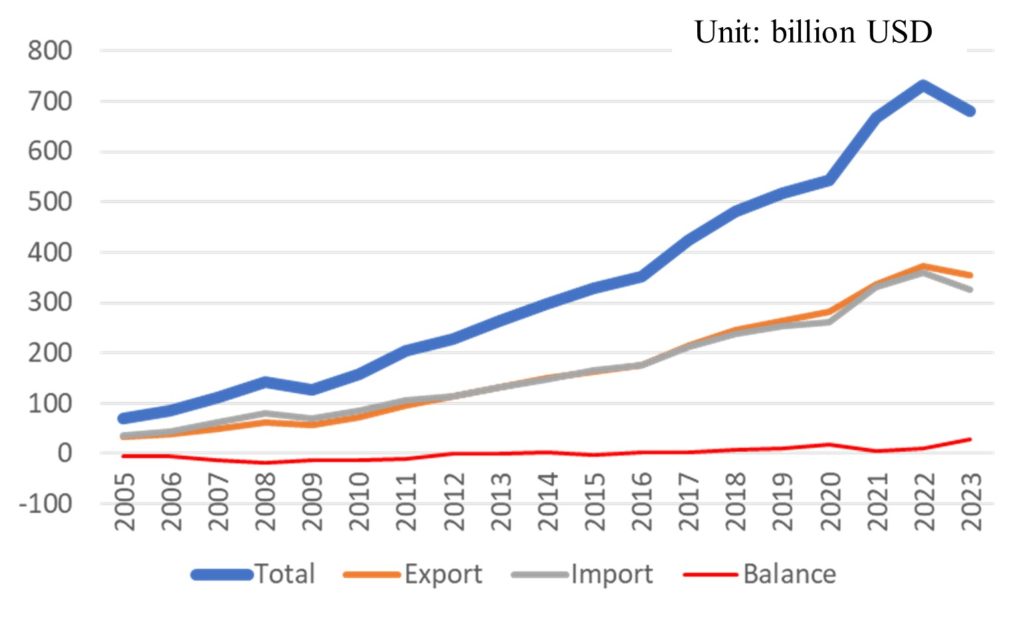
Figure 2 Viet Nam import-export value
Source: author, based on GSO data
Major exports include electronic; textiles and garments; footwear; seafood; and agricultural products. Major imports comprise machinery and equipment, petroleum products, steel, and raw materials. Principal import-export markets are China, South Korea, Japan, the US, and the European Union (EU).
In terms of FDI inflow, Viet Nam has become an attractive destination due to its strategic location, young population, political stability, and economic growth potential. FDI growth rate from 2007 to present (see Figure 3) reached a record high of 38.95 billion USD in 2019.
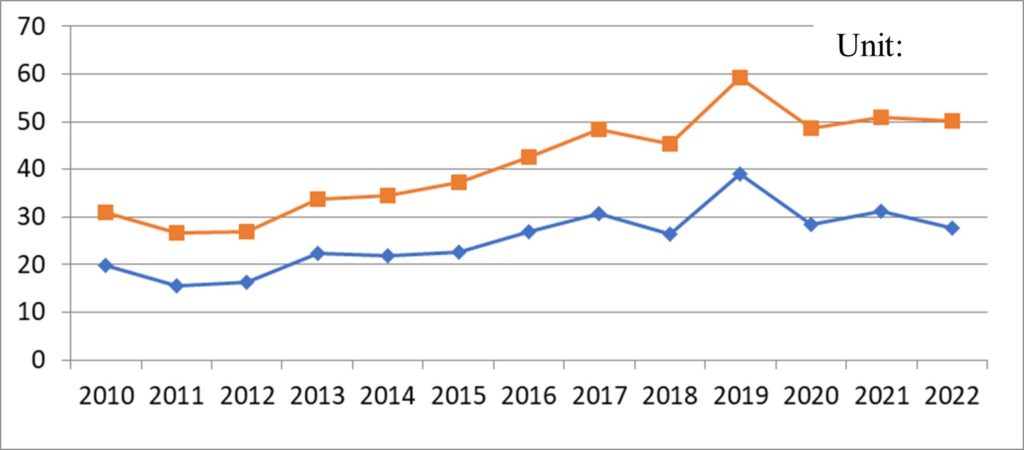
Figure 3 FDI implemented and registered in Viet Nam 2010-2022
Source: author, based on GSO statistic
Manufacturing is a dominant factor for FDI inflow, accounting for nearly 50% of total FDI in electronics, textiles, and the automotive industry. Asian countries, particularly South Korea, Japan, and Singapore are the largest investors, accounting for over 60% of total FDI.
US and EU companies have also increased investments in Viet Nam, especially in the high-tech electronics and automotive sectors. FDI concentrates in major urban areas and business hubs such as Ha Noi, Ho Chi Minh City, Bac Ninh, Dong Nai, and Binh Duong.
This context encourages development in Viet Nam of economic corridors, defined in the “Synthesis report on National Master Plan for the period 2021-2030, with a vision to 2050” (Government, 2023) as “an economic development space formed on the basis of a vital transportation axis, including includes urban areas and economic centers connected along the transport axis, creating motivation for the development of the entire route, while also spreading and attracting the development of neighboring areas”.
The terms transport corridor and economic corridor are apparently used interchangeably, with no definition of multimodal transport or logistics corridor.
Nevertheless, Viet Nam is included in significant economic corridors, such as the East West Economic Corridor (EWEC); the North South Economic Corridor (NSEC), and the Southern Economic Corridor (SEC). These aim to improve connectivity and facilitate trade and investment between Viet Nam and its neighbors.
This research comprises three parts plus introduction and conclusion:
- Economic corridor development in Viet Nam
- Challenges to Vietnamese economic corridor development
- Overcoming economic corridor development obstacles?
2. Economic Corridor Development in Viet Nam
Development of economic corridors in Viet Nam has significantly impacted national economic growth and regional integration, closely linked to regional cooperation efforts, especially in the Greater Mekong Subregion (GMS). Coordinating with neighboring countries is essential for addressing cross-border issues and maximizing benefits of economic corridor development. Viet Nam has advanced in developing transport infrastructure, facilitated cross-border trade, and attracted investments along its economic corridors. These efforts have contributed to improved connectivity, economic growth, and job creation.
According to Vitranss 2, (Viet Nam National Transport Strategy Study – VITRANSS 2), twenty-seven transport corridors (see Figure 4) have been identified for assessment of the following factors:
- recognition as primary transport routes.
- strategic importance from national and regional development perspectives and supported by current government policy;
- would have greater development potential with improved accessibility.
The corridors in question were initially assessed based on network analysis by the traffic assignment model. This involved estimating the number of road lanes needed to meet additional transport demands of interprovincial passengers and goods. Although the analysis relies on some assumptions, results give anticipated capacity constraints, and relative importance, of the seven corridors: North South Coastal corridor (Ha Noi–Ho Chi Minh City): Ha Noi-Hai Phong-Quang Ninh corridor; Hanoi-Ninh Binh/Nam Dinh corridor; Hue–Da Nang-Hoi An corridor; Nha Trang-Da Lat–Ho Chi Minh City corridor; Ho Chi Minh City-Vung Tau corridor; and Ho Chi Minh City-Can Tho corridor.
The National Master Plan for the period 2021-2030, with a vision to 2050 does not distinguish between national, bilateral, regional, or international economic corridors, but is divided into two major corridors: North-South and East-West. These consider ten priority economic corridors for development, structured mainly from transport corridors mentioned in Japan International Cooperation Agency (JICA) research (VITRANSS) 2).
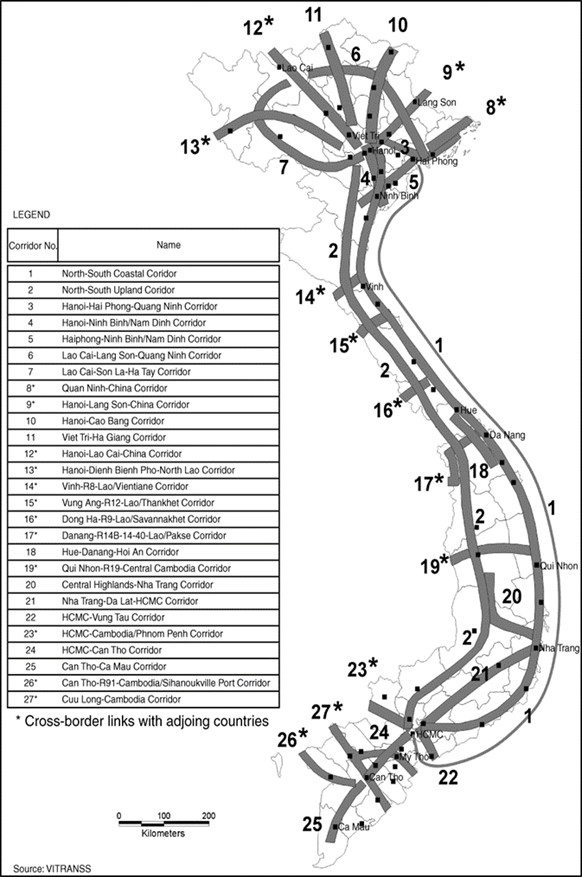
Figure 4 Transport corridors in Viet Nam by VITRANSS
2.1. National Economic Corridor Development
The Vietnamese government has recognized the importance of economic corridor development and tried to implement different policies and strategies. On the national level, the government established Vietnam’s Socio-Economic Development Strategy for the Period of 2011-2020 and The National Master Plan for 2021-2030 with a vision to 2050, which emphasize economics corridor development as a means of promoting nationwide connectivity and balanced growth. These policies aim to improve transport infrastructure, facilitate trade and investment, and create economic clusters and growth poles along the corridors.
Regionally and internationally, Viet Nam participates in initiatives to develop economic corridors, including the GMS Economic Cooperation Program. These initiatives strive to boost regional connectivity and promote trade, investment and cooperation among participating countries.
The history of economic corridor development in Viet Nam may be divided into different eras shaped by diverse national and international initiatives.
Before 1975
Historically, Viet Nam was connected to regional and international trade networks through ancient trade routes such as the Maritime Silk Road.
After the national reunion (1976-1980)
The government initiated the Second Five-Year Plan (1976-1980) to build its economy. The plan focused on infrastructure development and industriali-zation, laying the groundwork for the creation of economic corridors.
GMS 1998
In 1998, the GMS Economic Cooperation Program was launched, leading to development of three corridors such as: EWEC, NSEC and SEC. Viet Nam also participates actively in GMS economic corridors.
Belt and Road Initiative (BRI) in 2013
In 2004, Viet Nam and China agreed on the Two Corridors, One Belt (TCOB) connectivity initiative to strengthen bilateral economic cooperation, focusing on developing economic corridors connecting the five provinces Kunming, Nanning, Ha Noi, Hai Phong, and Quang Ninh, as well as promoting cooperation along the Northern Key Economic Region. After 20 years of development and cooperation, this economic corridor has proven effective. The five provinces and cities in this economic corridor aspire to connect more railways and airlines to diversify forms of transport logistics, reduce costs ,and develop a modern, sustainable supply chain.
The Chinese government launched the Belt and Road Initiative (BRI) in 2013, which includes the TCOB initiative. Like other such ventures, the BRI aims to improve regional connectivity.
Current economic corridors
The National Master Plan for 2021-2030 with a vision to 2050 focuses on developing economic corridors along the north-south and east-west axes based on highways, railways, connecting seaports, international airports, international border gates, and major trade hubs associated with urban areas and economic centers. Particular priority is given to economic corridors associated with the national economic center to promote growth and spillover effects. There are ten economic corridors (Figure 5).
- Two significant economic corridors are along the North-South axis:
- North-South economic corridor (Lang Son–Ha Noi–Ho Chi Minh City–Ca Mau) is formed based on the intersection of axes of the North – South expressway located in the East, National Highway 1A, North-South railway and high-speed railway in the future. This economic corridor has a particularly important position, making a major contribution to the country’s socio-economic development, connecting economic driving force areas, large urban areas, and economic centers, promoting economic development of the coastal strip and the western region of the country.
- Economic corridor along Ho Chi Minh Highway and North–South Highway through the Central Highlands and Southeast regions aims to promote the development of regional connectivity, associated with strengthening national defense and security.
- Eight East-West economic corridors:
- Lao Cai–Ha Noi-Hai Phong-Quang Ninh economic corridor directly influence the developmenet of 9 northern provinces and cities from Lao Cai to Hai Phong. This economic corridor is the main connection axis of the Northern dynamic economic zone, connecting the Northern Midlands and Mountains with the economic centers and major seaports of the whole country. It promotes trade and investment cooperation between Vietnamese provinces and the southwestern region of China (Kunming).
- Moc Bai-Ho Chi Minh City-Bien Hoa-Vung Tau economic corridor starts from Moc Bai border gate (Tay Ninh) through Ho Chi Minh city and ending at Ba Ria-Vung Tau seaport. It is associated with the trans-Asia economic corridor, is the gateway to the sea of the Southeast region, promoting economic development in the Southeast region, Mekong Delta and Central Highlands.
- Dien Bien-Son La-Hoa Binh–Ha Noi economic corridor connects the Northwest region with the Red River Delta, links with the North-South economic corridor and connects with the Northern region of Laos, promotes socio-economic development in the Northwest region.
- Cau Treo-Vung Ang economic corridor connects East – West located in Ha Tinh province, but it has important significance for the development of the North Central region; connecting localities of Laos PDR as well as countries in the GMS with Vietnam’s seaports. In addition, this also connects with the Cha Lo border gate and Hon La economic zone of Quang Binh province, promoting the development of the Cha Lo – Hon La corridor section.
- Lao Bao-Dong Ha-Da Nang economic corridor starting from Lao Bao border gate Dong Ha city (Quang Tri) and ends at Da Nang port. It is part of the EWEC of GMS, promoting trade, tourism, and investment exchanges between countries, developing localities in the North Central region and Central Coast.
Bo Y-Pleiku-Quy Nhon economic corridor passes through 3 provinces of Kon Tum, Gia Lai and Binh Dinh in the Central and Central Highlands regions. This economic corridor has important significance connecting the Northern Central Highlands provinces with the South Central provinces and seaports, promoting socio-economic development in the Central Highlands and South Central regions. - In addition, the Pleiku – Le Thanh expressway, connecting the development of the Quy Nhon – Pleiku economic corridor with Le Thanh border gate and Cambodia’s National Highway 78, promoting the development of the Pleiku – Le Thanh economic corridor section.
- Chau Doc-Can Tho-Soc Trang economic corridor passes through 4 provinces and centrally run cities including An Giang, Can Tho, Hau Giang and Soc Trang. This is an important economic and urban axis of the region, in the future connecting with Tran De seaport to take on the role of a gateway port in the Mekong Delta region.
- Ha Tien-Rach Gia-Ca Mau economic corridor connects the coastal provinces in the southwest of the country, including Kien Giang and Ca Mau provinces, associated with the Gulf of Thailand, located in the Southern Coastal Corridor of the Greater Mekong Subregion. This corridor has the impact of promoting the socio-economic development of the western coastal area of the Mekong Delta and the entire region.
2.2. Bilateral Economic Corridor
Policies have linked Viet Nam with China through bilateral economic corridors. One such is the BRI agreement between Viet Nam and China, aiming to promote bilateral economic cooperation by developing the following corridors:
- Kunming-Ha Noi-Hai Phong economic corridor: Connecting Kunming in China’s Yunnan Province with Ha Noi and Hai Phong in Viet Nam. This corridor focuses on transport, trade, and tourism development
- Nanning-Lang Son-Ha Noi-Hai Phong-Quang Ninh economic corridor: Linking Nanning in China’s Guangxi Province with Lang Son, Ha Noi, Hai Phong, and Quang Ninh in Viet Nam. This corridor aims to enhance cross-border trade and investment
With Cambodia, under the Agreement on the Transit of Goods between the Government of Viet Nam and the Government of Cambodia, singed in 2013, there are 10 pairs of border gate permitting transit goods (Table 1).
Table 1 Pairs of border gate permitting transit goods
| Number | Vietnam’border gate | Vietnam’ route | Cambodia’ border gate | Cambodia’ route |
| 1 | Vinh Xuong (An Giang) | Tien river – Cuu Long | Kaom Samnor (Kandal) | Mekong river |
| 2 | Thuong Phuoc (Dong Thap) | Tien river – Cuu Long | Koh Roka (Prey Veng) | Mekong river |
| 3 | Moc Bai (Tay Ninh) | National route Nᴼ22A | Ba Vet (Svay Rieng) | National route Nᴼ1 |
| 4 | Xa Mat (Tay Ninh) | National route Nᴼ22B | Trapang Phlong (Tbong Khmum) | National route Nᴼ72 |
| 5 | Le Thanh (Gia Lai) | National route Nᴼ19 | Oydav (Ratanakiri) | National route Nᴼ78 |
| 6 | Hoa Lu (Binh Phuoc) | National route Nᴼ13 | Trapeang Sre (Kratié) | National route Nᴼ74 |
| 7 | Tinh Bien (An Giang) | National route Nᴼ91 | Phnom Den (Takéo) | National route Nᴼ2 |
| 8 | Ha Tien (Kien Giang | National route Nᴼ80 | Prek Chak (Kampot) | National route Nᴼ33A |
| 9 | Dinh Ba (Dong Thap) | National route Nᴼ30 | Banteay Chakrei (Prey Veng) | Provincial route Nᴼ30 |
| 10 | Binh Hiep (Long An) | National route Nᴼ62 | Prey Vor (Svay Rieng) | Provincial route Nᴼ314D |
Source: The Agreement on the Transit of Goods between the Government of Viet Nam and the Government of Cambodia, singed in 2013
For Lao PDR borders, EWEC is mainly in the GMS framework. Busy border markets like those at the Viet Nam-China frontier are almost nonexistent.
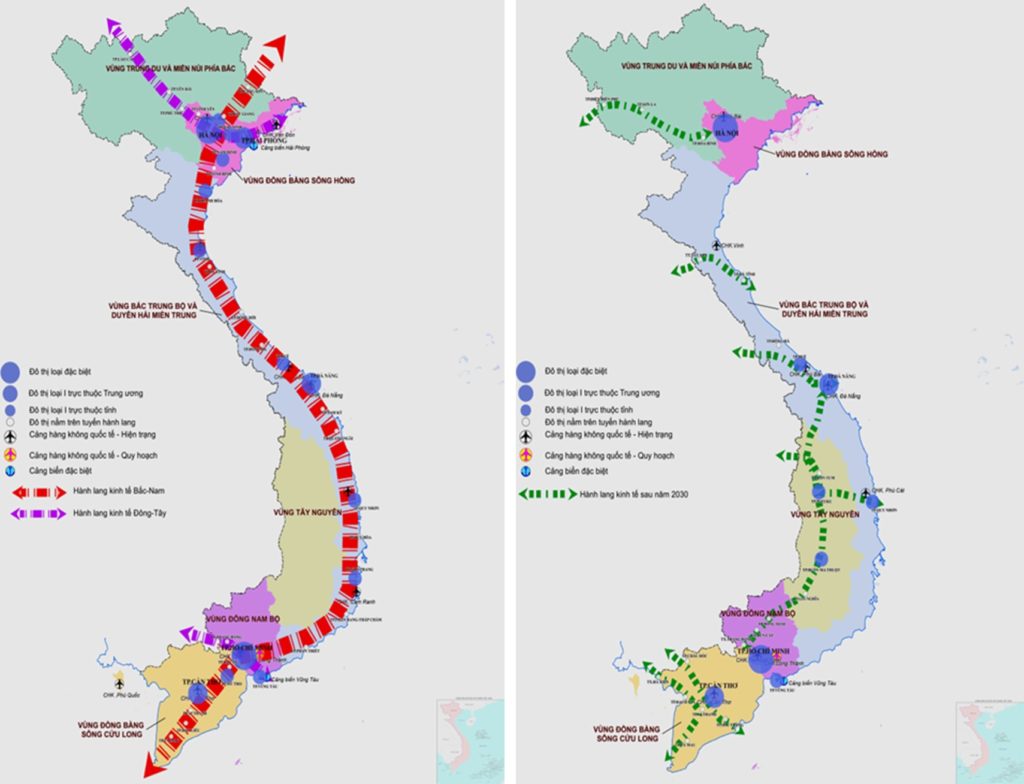
Figure 5 Ten national economic corridors of Vietnam
Source: The National Master Plan for the 2021-2030 period with a vision to 2050
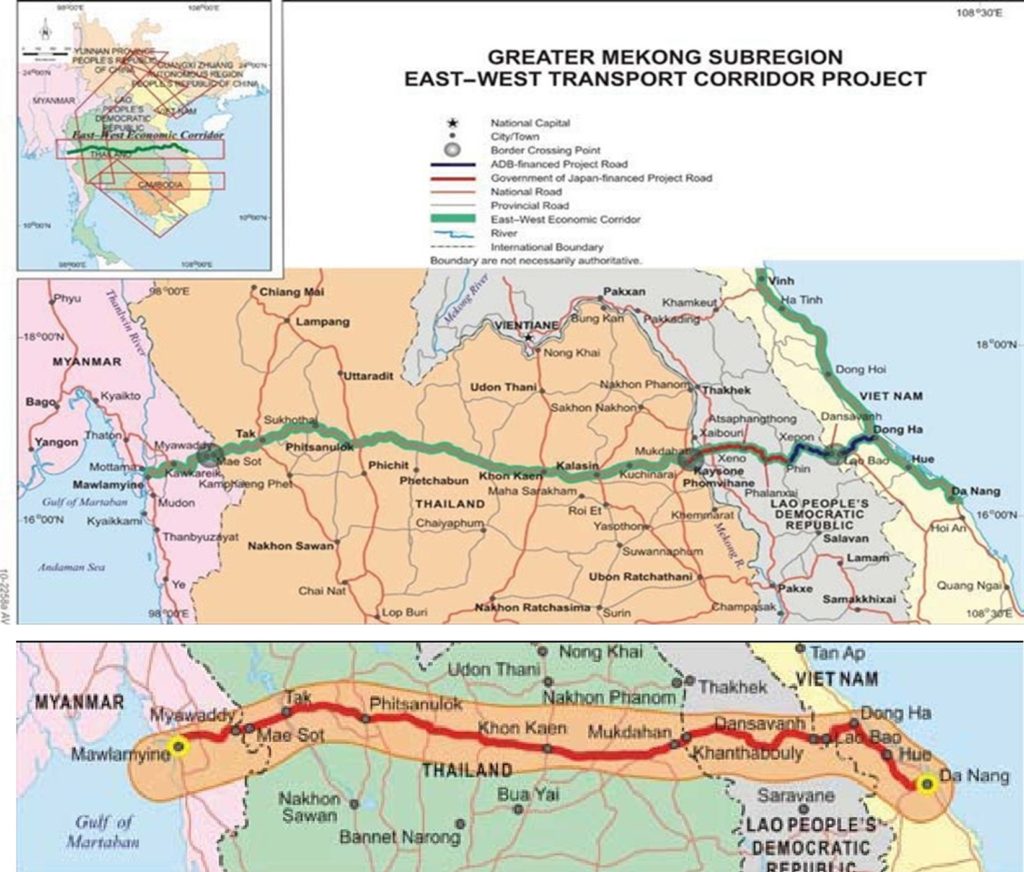
Figure 6 The East West Economic Corridor Nodes
Source: ADB(2010)
The EWEC extends 1,320 km as a continuous land route between the Andaman Sea in the Indian Ocean and the East Sea. Vietnamese provinces bordering the corridor include Da Nang, Thua Thien Hue, and Quang Tri. It contains the border node border checkpoints of Dansavanh–Lao Bao between the Lao PDR and Viet Nam.
There are 12 flagship projects classified under two broad categories of transport and other infrastructure, and managed by different forums or working groups (ADB2010):
- Core Transport
1.1. East–West Transport Corridor
1.2. Water transport development
1.3. Railway development
1.4. Air transport development
1.5. Cross-border facilitation in the movement of people and goods
1.6. Human resource development for the transport sector - Other Infrastructure
2.1. Electric power grid development
2.2. Promotion of regional energy cooperation arrangements
2.3. Telecommunications backbone development
2.4. Tourism development
2.5. Economic corridor initiatives
2.6. Initiatives of the Ministry of Economy, Trade and Industry (ASEAN–METI), Economic and Industrial Cooperation Committee (AMEICC), and Working Groups on West–East Corridor Development
The corridor concept has provided a holistic approach to the spatial development of impoverished areas of the GMS by focusing on investments in priority sectors such as transport, energy, telecommunications, trade and investment, to maximize the development impact and minimize cost.
The concept of border town development exists in Viet Nam as a focus of governmental efforts to promote regional connectivity and economic growth. The border town development is often integrated into broader strategies for economic corridor development in Viet Nam. It plays a crucial role in facilitating cross-border trade, investment, and cooperation between Viet Nam and its neighbors, especially China.
Key border towns in Viet Nam such as Mong Cai, Lao Cai, and Dong Dang have been prioritized for infrastructure development, trade facilitation, and investment promotion to enhance their roles as cross-border trade gateways.
The Vietnamese government has implemented policies and initiatives to support border town development, including:
- Developing transport infrastructure: upgrading roads, railways, and border gates to improve connectivity.
- Enhancing trade facilitation: streamlining customs procedures, improving border management (TFA (Trade Facilitation Agreement of WTO) commitment).
- Strengthening local governance and planning: implementing development plans for border towns, focusing on urban planning, infrastructure development, and social services.
- Promoting private sector involvement: encouraging private sector participation in border town development through public-private partnerships and investment incentives.
2.3. Regional Economic Corridors Development
GMS economic corridors and the Indonesia-Malaysia-Thailand Growth Triangle (IMT-GT) are vital for promoting regional integration and economic growth in Southeast Asia. However, as mentioned above, Viet Nam participates directly in the GMS economic corridor, although not a member of IMG-GT or BIMSTEC.
GMS Economic Corridor
- EWEC: connecting Vietnam’s central provinces to Laos, Thailand, and Myanmar, it has made progress in developing transport infrastructure and promoting cross-border trade. Key projects include the Lao Bao-Dansavanh border gate and the expansion of National Highway 8.
- NSEC: linking Vietnam’s northern provinces to China, Laos, and Cambodia, it has seen significant infrastructure development, such as the Ha Noi-Lao Cai Expressway and the Kunming-Ha Noi-Hai Phong economic corridor.
- SEC: connecting Vietnam’s southern provinces to Cambodia and Thailand, it has developed infrastructure, such as the Ba Vet-Moc Bai border gate and the expansion of National Highway 22.
IMT-GT and BIMSTEC economic corridors
Viet Nam is not a member of these two corridors but supports every potential regional or international development cooperation project.
2.4. International Economic Corridor Development
In addition to the GMS economic corridor, Viet Nam has been involved in other international initiatives, such as the Belt and Road Initiative (BRI).
Belt and Road Initiative (BRI)
Launched by China in 2013, the BRI aims to enhance regional connectivity and cooperation through infrastructure development, trade, and investment. Viet Nam has engaged in bilateral cooperation with China on projects that align with BRI objectives, such as the Kunming–Hanoi-Hai Phong Economic Corridor and the Nanning-Lang Son-Hanoi-Hai Phong-Quang Ninh economic corridor.
3. Challenges to Economic Corridor Development in Viet Nam
3.1. Infrastructure challenges
3.1.1. Transport (road/rail/river/coastal/maritime and air)
Key challenges include:
- Infrastructure gaps: The major issue is inadequate and underdeveloped transport infrastructure. This includes poor road conditions, insufficient railway networks, and limited capacity at border crossings (especially border gates with China) and seaports.
- Difference in infrastructure quality: leading to unassured seamless connectivity and coordination with neighboring countries.
- Sustainable development: difficulty in connecting transport modes. Currently, the main important economic corridors are roads, with Vietnam’s seaport as end point. Only the Lao Cai–Ha Noi–Hai Phong corridor has parallel rail and road connections to Hai Phong port.
- Funding constraints: Mobilizing sufficient financial resources for transport infrastructure development is an ongoing challenge, requiring innovative financing solutions and partnerships with the private sector and international organizations.
3.1.2. Other Facilities (such as dry ports/warehouses/DC/fulfilment center)
Several challenges must be addressed to optimize other facility (ICD, DC) contributions to economic corridor development:
- Inadequate infrastructure: Many warehouses, DC in Viet Nam lack modern equipment, affecting operational efficiency and competitiveness. The border gates with China are always under renovation. Others with Lao PDR and Cambodia are small and lack modern facilities.
- Limited intermodal connectivity: The system lacks rail and inland waterway network.
- Lack of skilled personnel: affecting efficiency and ability to meet international standards.
Currently, there is some warehouse infrastructure along the economic corridor. Vinh Phuc dry port (project invested by YCH and Vietnamese TNT group) is considered as the largest dry port in Southeast Asia, located on the NSEC connecting China with ASEAN countries. There have been plans for industrial parks along the corridor, but implementation progress for all is still limited, except industrial parks in large cities (Ha Noi, Hai Phong, Ho Chi Minh-city, and Da Nang).
3.2. Institutional challenges
The focus here will be on implementation of diverse trade and transport facilitation agreements such as WTO-TFA/ASEAN/GMS, bilateral agreements. Theoretically, there are not many difficulties. Like other countries, Viet Nam is implementing TFA, so customs clearance procedures are more open and easy than a decade ago. But how the mechanism is applied to propel participating parties along economic corridors to create a flow of goods remains a problem.
Economic corridor development appeared in the National Master Plan for the 2021-2030 period with a Vision to 2050. However, some challenges to economic corridor development in Viet Nam remain:
- Regulatory inconsistencies: The existence of overlapping, conflicting regulations across different levels of government and sectors can create confusion and uncertainty for investors and businesses.
- Complex administrative procedures: Lengthy administrative procedures for investment approval, land acquisition, and customs clearance can increase costs, cause delays, and discourage investment.
- Tax policies: Inconsistent and unpredictable policies can create uncertainties for businesses and investors, affecting investment decisions and overall attractiveness of economic corridors.
- Cross-border infrastructure coordination: Inconsistent rules and regulations regarding the planning, financing, and operation can create challenges developing economic corridors
- Non-tariff barriers: such as technical regulations, sanitary and phytosanitary measures, and import licensing requirements. Currently, China has implemented high level of sanitary and phytosanitary measures for Vietnamese products entering China, limiting benefits of economic corridors.
3.3. Logistics Service Provider Challenges
In recent years, the logistics industry in Viet Nam has had a significant annual growth rate of 14% to 16%, contributing about 3% to national GDP (MOIT, 2022). The Logistics Performance Index (LPI) published by the World Bank shows that Viet Nam ranks 43rd of 160 countries, and fourth in the ASEAN region, after Singapore, Malaysia and Thailand (World Bank, 2023).
The logistics market in Viet Nam is diverse and competitive. It is relatively fragmented, with a mix of local and foreign players.
The GSO indicates that there are currently 43,568 businesses operating in the field of transportation and warehousing, with 5,000 businesses providing third-party logistics (3PL) services. However, 95% of these are SMEs, 89% are domestic enterprises, 10% are joint venture enterprises and 1% are 100% enterprises. Foreign capital provides global logistics services, with leading names among the 50 largest logistics companies: DHL, UPS, FedEx, Kuehne + Nagel, DSV, and DB Schenker. Major Vietnamese players include Gemadept, Vinafco, VN Post, Viet Nam Maritime Corporation (VIMC), and Bee Logistics.
In terms of market share, foreign businesses provide better international logistics and warehouse services, while Vietnamese businesses have advantages in domestic logistics services. Vietnamese enterprises mainly focus on providing domestic transportation, forwarding, warehousing, customs procedures, and goods inspection. Compared to foreign enterprises, Vietnamese businesses hold considerable infrastructure and assets to serve logistics activities, with the advantage of understanding local business practices and domestic customers. However, their operations, financial capacity, and management skills are limited. They serve certain segments without a thorough connection to providing integrated logistics services.
Local logistics service providers often have a better understanding of the local market and regulatory environment, but they may lack resources and expertise of larger international players. Foreign logistics companies bring global best practices, advanced technology, and extensive networks, but may face challenges adapting to the local market and regulatory environment. Local logistics providers may also have more experience in operating along specific economic corridors in Viet Nam, especially those connecting major urban centers and economic hubs. However, international logistics companies often have expertise in managing complex cross-border logistics operations, which may be valuable for businesses operating in multiple countries along regional economic corridors.
In sum, the context of Vietnam’s logistics service market is currently competitive, revealing weaknesses such as lack of connection between industry businesses and high service costs, with inadequate service. At present, there is a shortage of large leading national enterprises to set trends and directions for attracting and promoting logistics services nationwide.
3.4. Manufacturing, Trading, and Investing challenges
Vietnamese businesses are highly interested in developing economic corridors with potential access to a GMS market of over 240 million consumers. Regional corridors link Viet Nam with other Asia-Pacific countries and the global supply chain, providing access to a sizeable market and opportunities for Vietnam’s export-driven economy.
Potential sectors for developing economic corridors in Viet Nam:
- Manufacturing sector: economic corridor development can support industrial growth for electronics, automobiles, and textiles by enhancing connectivity and facilitating market access.
- Logistics services: in addition to manufacturing sector demands, the growth of e-commerce and cross-border e-commerce creates opportunities for logistics companies operating in economic corridors.
- Tourism industry: Vietnam’s rich cultural heritage and natural beauty allow tourism development along economic corridors to promote regional growth and generate employment opportunities.
- Agricultural sector: economic corridors may improve market access for agricultural producers, promoting growth of high-value crops, aquaculture, and livestock.
Potential investor participation in economic corridor development in Viet Nam
Multinational corporations (MNCs) can bring significant capital, expertise, and technology to support development of infrastructure, industries, and services along economic corridors. Their involvement may also help attract additional investments and create jobs.
Local companies, especially in manufacturing, logistics, and tourism, can drive growth along economic corridors by expanding operations and attracting investments. They can provide development efforts tailored to the needs of local businesses and communities.
Attracting these types of investors can help to mobilize the necessary financing, expertise, and technology to drive sustainable and inclusive growth along economic corridors in Viet Nam.
4. Overcoming economic corridor development challenges
4.1. The role of stakeholders in overcoming economic corridor development challenges
To overcome economic corridor development challenges requires active collaboration from different stakeholders.
- The government should develop supportive policies, ensuring political stability, and providing necessary public investments in infrastructure and human capital, establishing specific incentives to attract financial partners (banks).
- The private sector can invest in infrastructure, industries, and services, and engage in public-private partnerships (PPP) to support development efforts.
- Research and academic institutions can provide evidence-based research, policy recommendations, and capacity-building support to inform and guide economic corridor development efforts.
- The media raises public awareness of economic corridor development issues, holding stakeholders accountable, and promotes transparency and good governance.
Effective communication, coordination, and collaboration among stakeholders are key to ensuring successful development of economic corridors.
4.2. Who should take the lead to overcome economic corridor development challenges?
Among different stakeholders, the government should lead as coordinator and facilitator, uniting different stakeholders in the private sector and academia to collaborate on development efforts.
The government mobilizes public investments in infrastructure, human capital, and other public goods necessary for economic corridor development. The top-down principle is relevant in this context.
4.3. Priorities needed to overcome economic corridor development challenges
Overcoming economic corridor development challenges requires setting clear priorities to guide the efforts of all stakeholders:
- Infrastructure
Investing in transport, energy, and telecommunications infrastructure is essential for improving connectivity, reducing logistics costs, and promoting economic integration along economic corridors.
In addition to infrastructure projects that have been, and are being, built, it is necessary to prioritize public investment; create conditions for preferential mechanisms and policies for the private sector and the FDI sector to participate in public-private cooperation projects to build traffic axes and major traffic hubs (seaports, airports), border gates, and feeder roads along traffic axes expected to become economic corridors.
It is also necessary to prioritize infrastructure development that can conveniently connect to multimodal transport and green transport corridors, with emphasis on the role of railways.
Implementation of bilateral and multilateral agreements on infrastructure must continue, especially with transport infrastructure (different transport modes) to facilitate the transport of goods and passengers crossing the border, multimodal transport within ASEAN, GMS, and with neighbouring countries. - Institutional framework
Feasible policy mechanisms must encourage logistics service development along the corridor. Regulations and supporting policies may be in place, but their enforcement is weak or impossible. At border gates, it is necessary to effectively implement TFA to reduce non-tariff barriers. - Develop logistics enterprises
This is a supply perspective on logistics services. It is necessary to consider attracting logistics businesses investment and presence in economic corridors to facilitate circulation of goods and passengers. Priority should be given to businesses investing in/providing a full package of logistics services rather than enterprises with strengths in one or a few services. This will avoid business fragmentation, ensure better service, and stimulate the logistics service outsourcing. - Develop manufacturing and commercial enterprises
A key to logistics services development is the demand side. The public authority must plan and arrange investment incentives to develop urban areas, border gate economic zone systems (Mong Cai), and industrial parks (processing industries to exploit Vietnamese agricultural development in different regions), and tourist areas along the economic corridor.
Build a long-term cross-border import-export strategy, promote cross-border exchange of goods, and enhance the formation and connection with regional economic corridors. - Human resource development
Developing a skilled workforce and investing in education, training, and research are essential for supporting innovation, productivity, and competitiveness along economic corridors. Many economic corridors pass through poor residential areas with low education levels, so investment in education is essential to shorten the gap between residents far from the city and urban rdwellers. - Regional cooperation
To develop regional and international economic corridors, enhancing regional cooperation and coordination among countries sharing economic corridors can help align development strategies, improve cross-border infrastructure, and promote regional economic integration.
If arranged by priority,solutions related to the policy mechanism for economic corridor development are the most urgent, because economic corridor development is a matter of high concern for the state.
4.4. Policy recommendations to overcome economic corridor development challenges
As mentioned above, the role of the state is primordial in developing economic corridors, so the first recommendation is that the government must create a clear policy framework including long-term development strategies, investment plans, and regulatory reforms.
The government should prioritize public investments in transport, energy, and telecommunications infrastructure to improve connectivity and reduce logistics costs along economic corridors.
The State continues to reform to improve the ease of doing business such as simplifying administrative procedures, reducing regulatory burdens, and enhancing access to finance for businesses. The government should continue closely with the progress of implementing commitments in the TFA.
In the context of capital shortage, the PPP (public-private partnership) form is considered the most economically effective by creating an enabling environment for PPPs, including clear legal and regulatory frameworks, transparent procurement processes, and risk-sharing mechanisms.
The state and local governments should strengthen regional cooperation and coordination among countries sharing economic corridors, focusing on aligning development strategies, improving cross-border infrastructure, and harmonizing trade and investment policies. The countries must regularly revise the ASEAN and GMS agreements to ensure effective results.
The state must implement measures to ensure transparency, accountability, and good governance, such as open and participatory decision-making processes, anti-corruption, and effective monitoring and evaluation systems.
By implementing these policy recommendations, Viet Nam can overcome economic corridor development challenges and create a favorable environment for sustainable and inclusive growth along its economic corridors.
5. Summary
In the political and economic contexts of Viet Nam, developing economic corridors is an important strategy, lessening the regional development gap, exploiting Vietnam’s geographical location, and promoting trade exchanges with neighboring countries.
To develop an economic corridor achieving its potential, support and awareness from state management agencies is important, as indicated in the National Master Plan for the period 2021–2030, with a vision towards 2050.
Economic corridor development in Viet Nam offers lessons to potentially guide future projects and initiatives:
- Comprehensive planning: A well-planned and integrated approach to economic corridor development is crucial for success. This includes aligning the scope of work with regional and national development plans, prioritizing projects based on economic, social, and environmental criteria, and considering the needs of local communities.
- Policy and regulatory reforms in term of trade facilitation: Addressing regulatory and policy barriers, such as complex customs procedures, inconsistent regulations, and restrictions on foreign investment, can create a more conducive environment for economic corridor development.
- Institutional capacity: for clear roles and responsibilities, and effective coordination among government agencies, other stakeholders, are essential for the successful implementation of economic corridor projects.
- Social and environmental safeguards: Integrating these considerations into economic corridor development is essential for ensuring that projects are sustainable and equitable. This includes conducting thorough environmental and social impact assessments, engaging local communities in decision-making processes, and implementing measures to mitigate negative impacts.
- Regional cooperation: Coordinating with neighbouring countries and engaging in regional initiatives can improve connectivity and promote the efficient flow of goods, services, and people along economic corridors.
Governmental interest in developing economic corridors should contribute to the socioeconomic development of provinces along the economic corridor, especially impoverished regions of Viet Nam.
References
- Asia Development Bank – ADB (2010) – Strategic and Action Plan for the Greater Mekong Subregion East-West Economic Corridor, ISBN 9789290920700
- Government (2023) – Synthesis report on National Master Plan for the period 2021-2030, with a vision to 2050 (completed according to Resolution Nᴼ81/2023/QH15 dated January 09, 2023 of the National Assembly)
- Ministry of Industry and Trade – MOIT (2022) – Vietnam Logistics Report 2022, Cong Thuong Edition, https://valoma.vn/wp-content/uploads/2022/12/Bao-cao-Logistics-Viet-Nam-2022.pdf, accessed in 5th January 2024
- Ministry of Industry and Trade – MOIT (2023) – Vietnam Logistics Report 2023, Cong Thuong Edition, https://valoma.vn/tai-lieu/cong-bo-bao-cao-logistics-viet-nam-2023/, accessed in 5th January 2024
- United Nations – UN (2024) – 2023 UN Country Annual Results report of Viet Nam
- World Bank – WB (2020) – Viet Nam development Report 2019 Connecting Viet Nam for Growth and Shared Prosperity, ISBN 9786049514524
- World Bank (2023) – Conecting to Compete, Trade Logistics in the Global Economy, The Logistics Performance Index and its indicators, https://lpi.worldbank.org/international/global, accessed in 5th January 2024
- World Health Organization – WHO (2023) – World Health Stastics 2023: monitoring health for the SDGs, sustainable development goals, https://www.who.int/data/gho/publications/world-health-statistics, accessed in 20th March 2024