
Thai Centrality Phase 2 Project Presents “Thai Centrality in a Changing Regional Order” to the Deputy Prime Minister
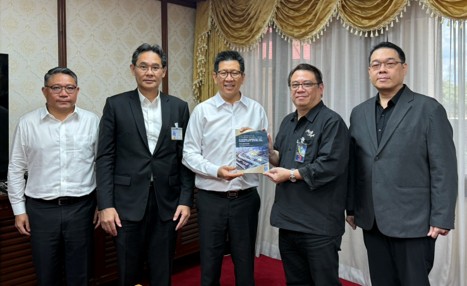
At the center: Dr. Ekniti Nitithanprapas, Deputy Prime Minister and Minister of Finance.
On the left: Mr. Danucha Pichayanan, Secretary-General of the National Economic and Social Development Council (NESDC), and Mr. Archawat Chareonsilp, Assistant to the Deputy Minister of Finance
On the right: Professor Dr. Ruth Banomyong, Project Leader, and Dr. Paitoon Varadejsatitwong, Project Researcher.
ตรงกลาง: ดร.เอกนิติ นิติทัณฑ์ประภาศ รองนายกรัฐมนตรีและรัฐมนตรีว่าการกระทรวงการคลัง
ด้านซ้าย: นายดนุชา พิชยนันท์ เลขาธิการสภาพัฒนาการเศรษฐกิจและสังคมแห่งชาติ (สศช.)
นายอาร์ชวัส เจริญศิลป์ ผู้ช่วยรัฐมนตรีประจำกระทรวงการคลัง
ด้านขวา: ศาสตราจารย์ ดร.รุธิร์ พนมยงค์ หัวหน้าโครงการวิจัย
ดร.ไพฑูรย์ วราเดชสถิตวงศ์ นักวิจัยในโครงการ
On Friday, 15 May 2026, the research team from the Center of Excellence in Connectivity, Thammasat Business School, Thammasat University, led by Professor Dr. Ruth Banomyong, Principal Investigator, and Dr. Paitoon Varadejsatitwong, project researcher, presented the book “Thai Centrality in a Changing Regional Order: Economic Corridors and Connectivity Across Asia” to Dr. Ekniti Nitithanprapas, Deputy Prime Minister and Minister of Finance.
The book is a key academic output of the research project “Developing Regional Economic Corridors to Position Thailand as a Centrality Hub of Southeast Asia: Thai Centrality Phase 2”, supported by the Program Management Unit on Area-Based Development (PMU A), Ministry of Higher Education, Science, Research and Innovation. The study builds upon previous research on economic corridors in the Greater Mekong Subregion (GMS) and expands the analysis to examine Thailand’s connectivity with major trading partners beyond the subregion, including India, Japan, the Republic of Korea, and China’s Greater Bay Area (GBA).
“Thai Centrality in a Changing Regional Order” brings together and synthesizes knowledge from experts across several countries. It provides a comprehensive analysis of economic corridor development, regional connectivity, and Thailand’s strategic role amid rapidly changing economic and geopolitical conditions. The book highlights Thailand’s potential to move beyond being merely a “transit country” toward becoming a “connectivity hub” of Southeast Asia. This can be achieved by leveraging the country’s geographical position, transport and logistics infrastructure, economic corridors, trade routes, investment linkages, spatial development strategies, and international cooperation mechanisms in an integrated manner.
The knowledge presented in the book can serve as an important evidence base and strategic framework for supporting public policy formulation. In particular, it can contribute to the assessment of feasibility, economic value, impacts, and strategic directions for major national infrastructure development. It also supports the linkage of Thailand’s economic corridors with key partner countries and surrounding regions in ways that maximize benefits in logistics competitiveness, supply chain upgrading, investment attraction, and cooperation among government, private sector, and international partners.
The presentation of this book reflects the important role of policy-oriented research in connecting academic knowledge with national strategic decision-making. It supports the development of Thailand’s infrastructure, economic corridors, and logistics systems in alignment with long-term goals for economic development, spatial development, and national competitiveness. The book also contributes to strengthening the resilience of Thailand’s logistics and economic systems amid uncertainty in the global economic order, geopolitical dynamics, and international disruptions.
Overall, “Thai Centrality in a Changing Regional Order” represents a valuable academic contribution and is expected to support policy formulation, strategic planning, and the advancement of Thailand’s role as a regional connectivity hub in the future.
โครงการ Thai Centrality ระยะที่ 2 ส่งมอบหนังสือ “Thai Centrality in a Changing Regional Order” แก่รองนายกรัฐมนตรี
เมื่อวันศุกร์ที่ 15 พฤษภาคม 2569 คณะนักวิจัยจากศูนย์ความเป็นเลิศด้านการเชื่อมโยง (Center of Excellence in Connectivity) คณะพาณิชยศาสตร์และการบัญชี มหาวิทยาลัยธรรมศาสตร์ นำโดย ศาสตราจารย์ ดร.รุธิร์ พนมยงค์ หัวหน้าโครงการวิจัย และ ดร.ไพฑูรย์ วราเดชสถิตวงศ์ นักวิจัยในโครงการ ได้ส่งมอบหนังสือ “Thai Centrality in a Changing Regional Order: Economic Corridors and Connectivity Across Asia” ซึ่งเป็นผลผลิตจากโครงการวิจัย “การพัฒนาระเบียงเศรษฐกิจภูมิภาคเพื่อสร้างไทยเป็นศูนย์กลาง (Thai Centrality) แห่งเอเชียตะวันออกเฉียงใต้ ระยะที่ 2” ภายใต้การสนับสนุนของ หน่วยบริหารและจัดการทุนด้านการพัฒนาระดับพื้นที่ (บพท.) กระทรวง อว. ให้แก่ ดร.เอกนิติ นิติทัณฑ์ประภาศ รองนายกรัฐมนตรีและรัฐมนตรีว่าการกระทรวงการคลัง โดยหนังสือเล่มนี้ต่อยอดจากงานวิจัยระเบียงเศรษฐกิจในอนุภูมิภาคลุ่มแม่น้ำโขง (GMS) สู่การวิเคราะห์ความเชื่อมโยงของไทยกับคู่ค้าสำคัญนอกอนุภูมิภาค อาทิ อินเดีย ญี่ปุ่น สาธารณรัฐเกาหลี และเขตเศรษฐกิจ Greater Bay Area (GBA) ของจีน
หนังสือ “Thai Centrality in a Changing Regional Order” เป็นผลงานวิชาการสำคัญของโครงการวิจัย Thai Centrality ระยะที่ 2 ที่รวบรวมและสังเคราะห์องค์ความรู้จากผู้เชี่ยวชาญหลายประเทศ เพื่อสะท้อนภาพรวมของการพัฒนาระเบียงเศรษฐกิจ ความเชื่อมโยงระดับภูมิภาค และบทบาทเชิงยุทธศาสตร์ของประเทศไทยภายใต้บริบทเศรษฐกิจและภูมิรัฐศาสตร์ที่เปลี่ยนแปลงอย่างรวดเร็ว หนังสือเล่มนี้นำเสนอศักยภาพของไทยในการยกระดับบทบาทจาก “ประเทศทางผ่าน” ไปสู่ “ศูนย์กลางการเชื่อมโยง” ของเอเชียตะวันออกเฉียงใต้ โดยอาศัยจุดแข็งด้านที่ตั้งทางภูมิศาสตร์ โครงสร้างพื้นฐานด้านคมนาคมและโลจิสติกส์ ระเบียงเศรษฐกิจ เส้นทางการค้า การลงทุน การพัฒนาพื้นที่ และความร่วมมือระหว่างประเทศอย่างบูรณาการ องค์ความรู้ที่ปรากฏในหนังสือสามารถใช้เป็นฐานข้อมูลและกรอบคิดเชิงยุทธศาสตร์สำหรับสนับสนุนการกำหนดนโยบายของภาครัฐ โดยเฉพาะการประเมินความเป็นไปได้ ความคุ้มค่า ผลกระทบ และทิศทางการพัฒนาโครงสร้างพื้นฐานสำคัญของประเทศ ตลอดจนการเชื่อมโยงระเบียงเศรษฐกิจไทยกับประเทศคู่ค้าและภูมิภาคโดยรอบให้เกิดประโยชน์สูงสุด ทั้งในมิติการเพิ่มขีดความสามารถด้านโลจิสติกส์ การยกระดับห่วงโซ่อุปทาน การดึงดูดการลงทุน และการสร้างกลไกความร่วมมือระหว่างภาครัฐ เอกชน และประเทศพันธมิตร
การส่งมอบหนังสือในครั้งนี้จึงสะท้อนบทบาทของงานวิจัยเชิงนโยบายในการเชื่อมโยงองค์ความรู้ทางวิชาการกับการตัดสินใจเชิงยุทธศาสตร์ของประเทศ เพื่อสนับสนุนให้การพัฒนาโครงสร้างพื้นฐาน ระเบียงเศรษฐกิจ และระบบโลจิสติกส์ของไทยสอดคล้องกับเป้าหมายการพัฒนาเศรษฐกิจ การพัฒนาพื้นที่ และการเพิ่มขีดความสามารถในการแข่งขันในระยะยาว อีกทั้งยังช่วยเสริมสร้างความยืดหยุ่นของระบบโลจิสติกส์และเศรษฐกิจไทยท่ามกลางความไม่แน่นอนของระเบียบเศรษฐกิจโลก ภูมิรัฐศาสตร์ และภัยพิบัติระหว่างประเทศ หนังสือ “Thai Centrality in a Changing Regional Order” จึงเป็นผลผลิตทางวิชาการที่มีคุณค่าและคาดว่าจะเป็นประโยชน์ต่อการกำหนดนโยบาย การวางแผนยุทธศาสตร์ และการขับเคลื่อนบทบาทของประเทศไทยในฐานะศูนย์กลางความเชื่อมโยงของภูมิภาคในอนาคต